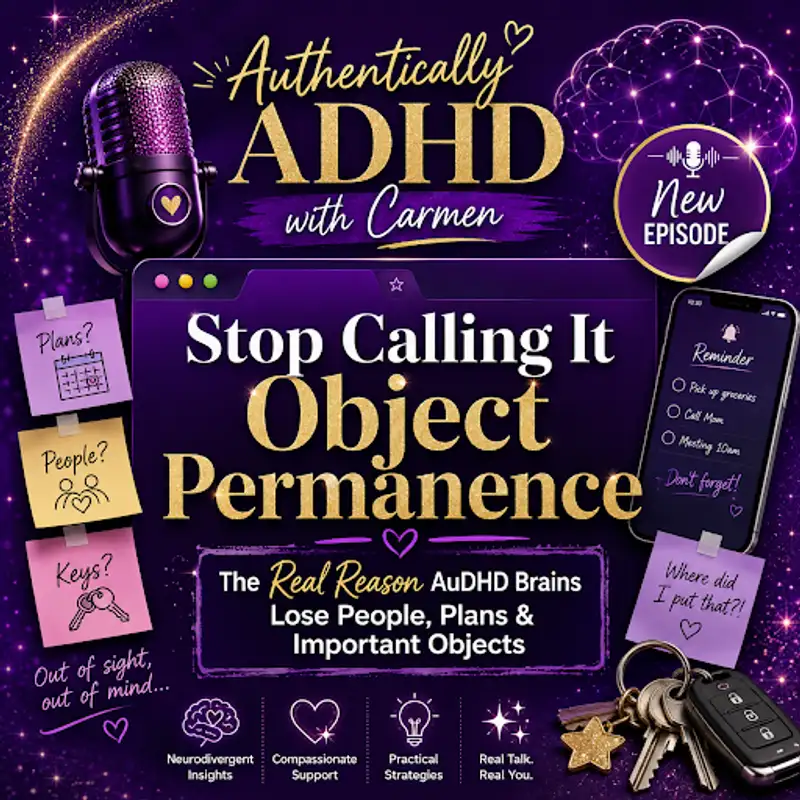
Your Brain Didn’t Forget They Exist—It Lost the Retrieval Cue
Download MP3Have you ever forgotten to text someone you deeply love, missed an appointment that genuinely mattered, or lost the important object you deliberately placed somewhere “safe”? It is often described online as an ADHD or AuDHD “object permanence” problem—but that is not quite what is happening.
In this episode of Authentically ADHD with Carmen, Carmen breaks down the real neuroscience behind why AuDHD brains lose track of people, plans, tasks, and everyday objects. She explores context-dependent recall, prospective memory, attention, memory encoding, and working-memory interference—and explains why information can still exist in your brain without becoming accessible at the moment you need it.
You will learn why walking into another room can erase your original mission, why future plans can disappear once the conversation ends, and why forgetting to contact someone is not automatically evidence that you stopped caring. Carmen also explores the important difference between having a neurological explanation and taking accountability when forgetfulness affects other people.
With validating insights, practical AuDHD strategies, and the appropriate amount of dark humor, this episode offers realistic tools for externalizing memory, creating stronger retrieval cues, connecting tasks to existing routines, designing visible homes for important objects, and supporting relationships without relying entirely on spontaneous recall.
Because memory is not a moral system. Your brain did not forget because nothing mattered—the present moment simply became louder than the thing you wanted to remember.